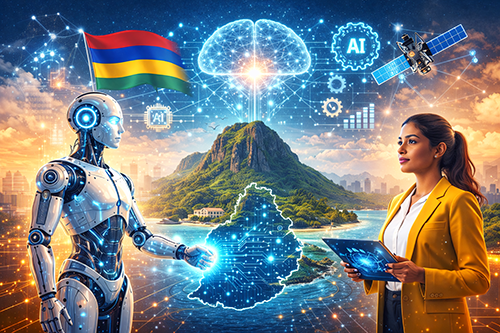
As artificial intelligence rapidly transforms global economies and governance systems, Mauritius is positioning itself as an agile, trusted, and innovation-driven digital hub in the Indian Ocean. In an exclusive and wide-ranging conversation with WorldAffairs News Network, Mauritius’ Minister of Information Technology, H.E. Avinash Ramtohul, laid out a comprehensive roadmap for how deeper India–Mauritius collaboration can advance inclusive AI adoption, strengthen digital sovereignty, enhance cyber resilience, and create a model of responsible AI governance tailored to emerging economies.
Minister Ramtohul underscored that inclusion must be intentionally designed into AI systems from the outset. Mauritius, he noted, already possesses strong digital fundamentals: 178 mobile subscriptions per 100 residents, broadband coverage reaching 96% of the population across 3G, 4G and 5G networks, 89% smartphone penetration in households, and internet usage standing at 80% as of January 2025. However, connectivity alone does not guarantee equitable digital transformation. The central challenge, he argued, is ensuring that AI enhances human capability rather than replacing it or marginalizing digitally vulnerable populations.
In this context, India’s experience in building and scaling digital public platforms for hundreds of millions of citizens offers powerful lessons. The Minister emphasized that collaboration between the two countries should focus on practical AI tools that are multilingual, affordable, disability-accessible, and adapted to local contexts. Applications in education, telemedicine, agricultural advisory systems, and public service delivery can significantly reduce structural inequalities if designed responsibly. Inclusion, he stressed, is not merely a social obligation but a strategic imperative for long-term economic stability and growth.
As a Small Island Developing State, Mauritius faces inherent constraints due to its limited domestic market size. Yet Minister Ramtohul views this not as a disadvantage but as a strategic opportunity. The country’s governance agility allows it to pilot regulatory sandboxes, test ethical AI frameworks, and refine policies with speed and coherence. Mauritius is currently advancing its Digital Transformation Blueprint under a Public-Private-People Partnership model, anchored in human-centered and innovation-friendly principles. Its strong cybersecurity posture and Tier 1 ranking further strengthen its credibility as a secure environment for digital experimentation.
Rather than replicating large-scale AI ecosystems, Mauritius aims to become a highly trusted, agile AI jurisdiction that leverages its size as an asset. Structured capacity-building partnerships with India, advanced research collaboration, joint training programs, and technical knowledge transfer will play a critical role in achieving this objective.
A central theme of the discussion was India’s globally recognized Digital Public Infrastructure (DPI) model. According to Minister Ramtohul, the strength of India’s framework lies not only in technological architecture but in its underlying philosophy interoperability, open standards, secure digital identity systems, and data empowerment at scale. Mauritius is examining elements of this model to strengthen AI-driven governance and public service delivery.
Interoperable digital identity ecosystems, for example, can enable secure and consent-based access to citizen data while preserving privacy. Open API frameworks can stimulate innovation by allowing startups and private sector actors to build AI-enabled value-added services on top of government platforms, thereby creating a dynamic digital economy rather than a closed administrative system.
Consent-driven data governance models are particularly significant, as AI systems depend heavily on quality datasets. Ensuring that citizens retain control over how their data is used fosters trust while enabling responsible innovation. These principles align closely with Mauritius’ forthcoming National AI Strategy and its FAIR governance guidelines emphasizing fairness, accountability, integrity, and responsibility alongside the country’s National Data Strategy.
Institutional coordination is another priority.
Minister Ramtohul highlighted the need to avoid digital silos by strengthening interoperability across ministries. AI-driven governance must function horizontally across sectors such as health, finance, education, land management, social protection, and regulatory oversight. However, adaptation remains essential. Mauritius does not seek to replicate India’s scale, but rather to contextualize and refine elements that suit its demographic profile and legal environment. Its advantage lies in the ability to integrate AI layers rapidly across digital public infrastructure and refine governance models in real time.
Mauritius also envisions itself as a strategic digital bridge between Africa and Asia. Located at a crossroads of major maritime and economic corridors, the country combines political stability, strong regulatory institutions, robust digital penetration, and a bilingual business environment. For Indian technology firms and startups, Mauritius offers a testbed for African expansion, a regulatory sandbox for emerging technologies, and a financial gateway into the wider Indian Ocean region. The Minister proposed joint incubation platforms, AI accelerators, co-investment mechanisms, and collaborative research initiatives that link Mauritian entrepreneurs with India’s innovation ecosystems.
Several sectors offer immediate potential for bilateral AI collaboration. Fintech stands out given Mauritius’ role as a financial hub and India’s global leadership in digital payments innovation. Climate resilience is another critical area, particularly for a small island state highly exposed to environmental risks. AI-driven predictive systems can strengthen disaster preparedness, environmental monitoring, and resource management. Maritime security across the Indian Ocean presents opportunities for AI-enhanced surveillance, logistics optimization, and port management. Tourism, a pillar of Mauritius’ economy, can benefit from smart analytics and visitor management systems. Healthcare, meanwhile, holds transformative potential in predictive diagnostics, epidemiology, medical imaging, and telemedicine, particularly for remote and vulnerable populations. Joint innovation tailored to emerging economy contexts could significantly improve public health outcomes while reducing costs.
Capacity building remains at the core of Mauritius’ AI strategy. Minister Ramtohul emphasized that without human capital, AI transformation will remain superficial. While Mauritius benefits from strong digital penetration, AI demands deeper specialization, including data scientists, AI engineers, cybersecurity analysts, ethicists, and policy architects. He outlined a three-tiered collaboration framework with India encompassing education, research, and industry integration.
At the educational level, joint AI fellowship programs, co-designed curricula between universities, faculty exchanges, and hybrid learning platforms can accelerate knowledge transfer. AI literacy should extend beyond technical disciplines to public administration, law, healthcare, and education to ensure cross-sectoral integration. At the research level, joint laboratories can focus on solving practical challenges faced by emerging economies, including climate modeling, digital health diagnostics, fintech compliance systems, maritime analytics, and AI governance frameworks. At the industry level, talent mobility should be circular rather than extractive. Mauritian professionals should gain exposure within India’s leading AI ecosystems and return with enhanced capabilities, while Indian experts can mentor startups and support applied AI deployment in Mauritius. The goal, he stressed, is brain circulation rather than brain drain.
Mauritius is also exploring the establishment of AI Centers of Excellence and regional training hubs that could position the country as a skills bridge between India and Africa. Ethical literacy must accompany technical proficiency to ensure that AI deployment remains responsible and human-centered.
On governance, Minister Ramtohul highlighted the need for adaptable regulatory models suitable for emerging economies. Collaboration between India and Mauritius can focus on practical standards for algorithmic transparency, explainability, risk classification, and accountability mechanisms. Data governance, privacy, and sovereignty are equally critical. As AI systems become embedded in financial services, healthcare, and public administration, secure data exchange frameworks and privacy-enhancing technologies must be strengthened. Mauritius’ agility allows it to function as a controlled environment to test AI governance mechanisms, while India’s scale and technical depth can validate and stress-test these frameworks.
Infrastructure development is another priority. While Mauritius already demonstrates high connectivity and digital penetration, the next phase involves scalable cloud environments, secure data centers, sovereign data governance structures, and advanced cybersecurity systems. Indian industry can contribute through investment partnerships and collaboration on secure compute ecosystems tailored to emerging markets. In the digital era, infrastructure represents strategic sovereignty.
Cyber resilience, in particular, demands close bilateral cooperation. AI-powered threat intelligence sharing, joint cyber exercises, adversarial AI research, model robustness testing, and secure-by-design architectures are essential as AI systems increasingly underpin critical infrastructure such as finance, telecommunications, energy, maritime systems, and healthcare. Protecting training data, preventing model manipulation, and ensuring system integrity are now central to national security.
Minister Ramtohul concluded with a clear message to Indian innovators and policymakers: Mauritius intends to be an active architect of the AI century. The country seeks to co-create solutions for Africa and beyond within a stable, trusted, and agile regulatory environment. Rather than viewing AI as a race for technological dominance, he called for a partnership model rooted in shared development goals.
In an era where digital corridors are becoming as strategically significant as maritime routes, Mauritius aims to anchor a secure and rules-based digital bridge linking Indian innovation with African opportunity. The partnership, he suggested, can demonstrate that technological advancement and human dignity are not competing objectives, but complementary ambitions shaping the future of the Global South.
The complete interview with the Minister of Information Technology, Mauritius, is featured in World Affairs News: Views & Analysis, published by the WorldAffairs News Network. The digital edition is also available online at www.thewnn.com.
-Chris Williams