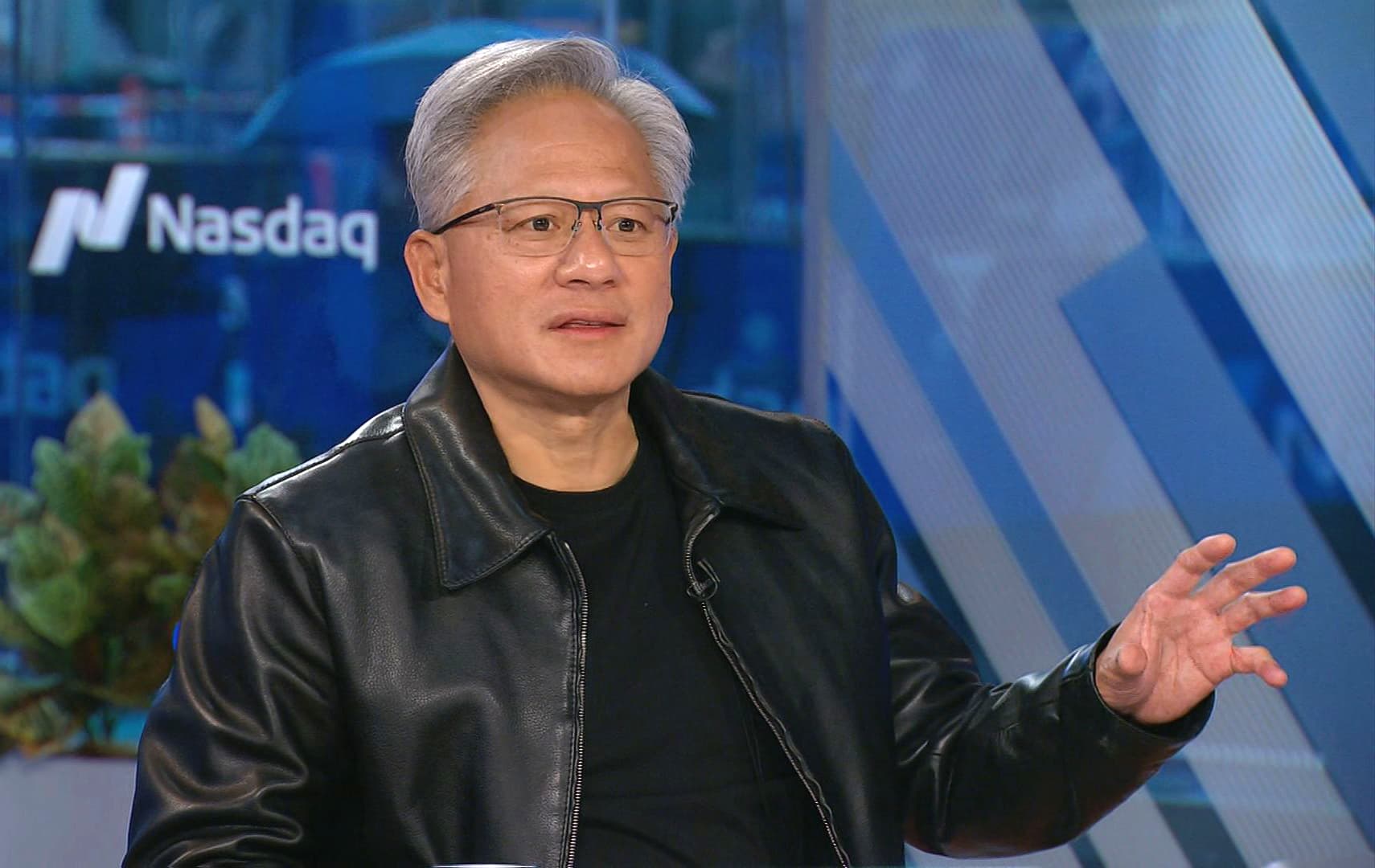
Nvidia’s stock surged sharply after its chief executive offered a confident defense of the technology sector’s rapidly expanding investment in artificial intelligence infrastructure, arguing that the current spending wave is not only justified but economically sustainable.
Speaking in a televised interview, Nvidia CEO Jensen Huang pushed back against growing investor anxiety over soaring capital expenditures, insisting that the scale of spending reflects real demand and a clear path to rising cash flows across the AI ecosystem.
The market appeared reassured. Nvidia shares closed nearly eight percent higher, outperforming much of the broader tech sector and reinforcing the company’s central role in the global AI buildout.
A defense of unprecedented AI infrastructure spending
Huang described the current investment cycle as a rational response to explosive demand for computing power rather than speculative excess. In his view, the enormous sums being committed by major technology platforms are supported by customers who are already paying for AI services and generating revenue from them.
As long as AI-driven products continue to attract paying users and businesses, Huang argued, spending on chips, data centers, and networking will naturally accelerate rather than slow down. He framed the trend as a compounding cycle, where higher usage drives more infrastructure, which in turn unlocks even greater economic returns.
Hyperscalers fuel Nvidia’s growth engine
Huang’s remarks followed a wave of earnings reports from Nvidia’s largest customers, including Meta, Amazon, Google, and Microsoft. Over the past two weeks, all four companies signaled aggressive increases in AI-related capital expenditures.
Combined, these hyperscalers are expected to spend as much as $660 billion on capital investments this year alone, with a substantial portion flowing directly into Nvidia’s graphics processing units and AI accelerators. While Wall Street’s reaction to these announcements was mixed, the sheer scale of planned purchases underscores how deeply Nvidia’s hardware is embedded in the AI strategies of the world’s largest platforms.
Mixed market reaction highlights investor tension
The market response to the spending surge has been uneven. Shares of Meta and Alphabet moved higher as investors focused on long-term competitive advantages, while Amazon and Microsoft faced pressure amid concerns about near-term free cash flow and margins.
Huang acknowledged the tension but emphasized that infrastructure spending should be viewed through a longer lens. He described the current moment as the largest infrastructure expansion ever undertaken, driven by demand that is already visible rather than hypothetical.
How AI is reshaping core products
To illustrate why the investment is necessary, Huang pointed to concrete changes underway inside Nvidia’s customer base. At Meta, artificial intelligence is transforming how content is recommended, shifting systems that once relied heavily on traditional CPUs toward generative AI models and autonomous agents running on GPUs.
Within Amazon Web Services, Nvidia-powered AI is being woven into the cloud platform itself, influencing everything from enterprise workloads to how products are recommended across Amazon’s retail ecosystem. Microsoft, meanwhile, is integrating AI more deeply into its enterprise software, using Nvidia hardware to enhance productivity tools and business applications used by millions of organizations.
These examples, Huang argued, demonstrate that AI is not a standalone product but a foundational layer reshaping existing services at scale.
The role of leading AI labs
Huang also highlighted the momentum at the forefront of AI research, pointing to OpenAI and Anthropic, two of the most prominent AI labs. Both rely heavily on Nvidia chips through cloud providers, reinforcing the company’s position at the center of the AI value chain.
Nvidia’s relationship with Anthropic goes beyond supply. The chipmaker invested roughly $10 billion in the company last year, signaling confidence not just in infrastructure demand but in the commercial potential of advanced AI models. Huang has also indicated that Nvidia plans to participate significantly in OpenAI’s next fundraising round.
According to Huang, these labs are already generating meaningful revenue, and access to additional computing power would amplify that growth. In his view, AI revenue does not scale linearly with compute but accelerates faster as capacity increases.
Sustained demand extends beyond new hardware
One of Huang’s more striking observations was about the longevity of demand. He noted that every generation of Nvidia GPUs sold in recent years is currently in use, including chips released six years ago such as the A100. Rather than being replaced, older hardware is still being rented and deployed, reflecting persistent demand across the AI ecosystem.
This dynamic challenges the notion that AI spending could abruptly stall once the latest generation of chips ships. Instead, it suggests a layered market where multiple generations of hardware remain economically valuable.
Cash flow optimism underpins Nvidia’s confidence
At the heart of Huang’s argument is his belief that cash flows across the AI industry will rise as infrastructure investments mature. As AI services become more deeply embedded in consumer platforms, enterprise software, and cloud offerings, revenues are expected to expand alongside usage.
From Nvidia’s perspective, this creates a virtuous cycle. Higher customer revenues justify continued infrastructure spending, which drives further demand for Nvidia’s chips and systems. Huang portrayed this feedback loop as the fundamental reason why today’s massive capital expenditures can be sustained over time.
Rather than viewing the AI buildout as a risky bet, Nvidia’s leadership sees it as the economic foundation of the next computing era, one where demand for accelerated computing becomes as essential as electricity or bandwidth.