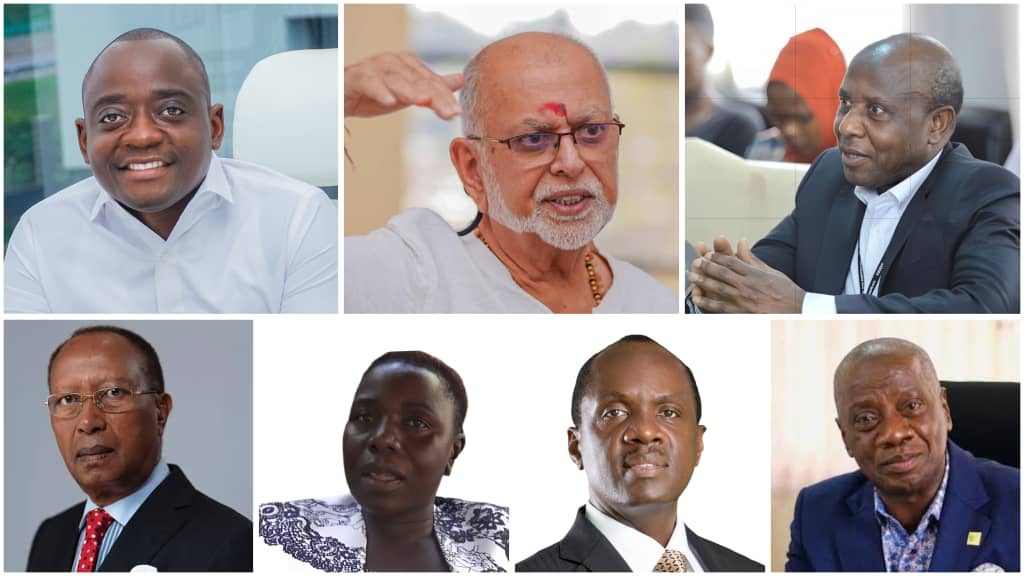
Uganda Private Capital now accounts for an estimated $10.3 billion in combined asset value among the country’s leading private wealth holders. In a $65 billion frontier economy, that concentration equals nearly one-sixth of national output. The numbers do not simply reflect individual success. They reveal how asset ownership, rather than public equity, defines economic power in Uganda.
Public markets remain shallow. The Uganda Securities Exchange lists relatively few companies, and equity participation is limited. As a result, wealth has accumulated primarily through commercial property, petroleum distribution, manufacturing, hospitality and telecom-linked equity exposure. The ranking below reflects indicative, asset-based estimates rather than audited declarations.
1. Hamis Kiggundu – ~$1.35 Billion
At the top of the Uganda Private Capital structure sits Hamis Kiggundu, whose valuation is heavily anchored in high-density commercial real estate across Kampala. Through successive development cycles, he has compounded capital by reinvesting operating cash flow into mixed-use towers and retail complexes.
His portfolio includes strategic land banking, beverage manufacturing operations in Nsangi and participation in fintech through Hamz Pay. International property exposure reportedly spanning London, Dubai and the United States adds geographic diversification. The core valuation driver, however, remains occupancy rates, land appreciation and recurring rental income.
2. Sudhir Ruparelia – ~$1.2 Billion
Sudhir Ruparelia represents one of Uganda’s most diversified conglomerate models. His holdings span commercial real estate, hospitality assets such as Speke Resort Munyonyo, insurance services, education institutions and export-oriented floriculture.
Unlike single-sector landlords, his structure layers property appreciation with operational revenue. Tourism cycles and foreign exchange movements influence part of his valuation, but diversified income streams provide stability within the broader Uganda Private Capital ecosystem.
3. John Bosco Muwonge – ~$850 Million+
Muwonge’s wealth is overwhelmingly tied to central business district property. His arcades and commercial buildings across Nabugabo Street, William Street and surrounding corridors generate rent-intensive income linked to retail density.
This model is straightforward: control prime inner-city land and maintain high tenant turnover. In Kampala’s dense trading zones, location remains the multiplier.
4. Drake Lubega – ~$800 Million+
Through Jesco Industries Limited, Lubega has accumulated extensive commercial holdings in high-footfall corridors such as Luwum Street and Kikuubo. His wealth is rent-driven and land-heavy.
Industrial warehouses and education assets add modest diversification, but property remains the anchor. His position underscores how central real estate is to Uganda Private Capital formation.
5. Mansour Matovu – ~$785 Million
Matovu transitioned from logistics and motorcycle imports into large-scale property development. His arcades and plazas across Kampala’s CBD generate recurring rental income from thousands of tenants.
Prime land positioning and tenant density define valuation. Like other urban accumulators, he reflects a property-first capital model.
6. Karim Hirji – ~$785 Million+
Hirji blends hospitality through the Imperial Hotels Group with commercial real estate and automotive distribution. Cham Towers anchors his land-backed capital base.
The hybrid structure mixes asset stability with tourism-linked operational revenue. Exchange rate movements and conference demand shape performance within his portfolio.
7. Christine Nabukeera – ~$710 Million+
Nabukeera’s wealth is concentrated in premium commercial and residential real estate. Ownership of landmark assets such as New Pioneer Mall positions her within Kampala’s high-value corridors.
Her valuation depends on rental yield performance and long-term land appreciation rather than diversified operating enterprises.
8. Tom Kitandwe – ~$700 Million+
Kitandwe evolved from trade into commercial development, constructing multi-storey buildings across Kampala’s busiest intersections.
Beyond property, he holds agribusiness land and telecommunications-linked investments. Real estate remains the dominant valuation driver, while agriculture introduces commodity exposure.
9. Guster Lule Ntake – ~$670 Million+
Ntake’s portfolio combines hospitality, agriculture and manufacturing. Unlike strictly rent-based magnates, he participates in food processing and beverage production, introducing value-added industrial scaling.
Property holdings provide balance-sheet stability, but operational performance influences much of his net worth.
10. Godfrey Kirumira – ~$615 Million+
Kirumira built wealth through petroleum distribution before stabilizing it through real estate and telecom mast infrastructure.
Fuel retail generates liquidity tied to transport demand. Commercial towers and hotel properties reduce sector concentration risk. His structure blends turnover-driven cash flow with land-backed assets.
11. Charles Mbire – ~$600 Million+
Mbire represents the equity-driven segment of Uganda Private Capital. His stake in MTN Uganda positions him among the largest individual shareholders on the Uganda Securities Exchange.
Unlike property magnates, his wealth fluctuates with corporate earnings, dividend policy and market performance. Energy and infrastructure investments further diversify exposure.
12. Amos Nzeyi – ~$550 Million+
Nzeyi’s wealth is industrially grounded. Through Crown Beverages Limited, the exclusive PepsiCo bottler in Uganda, his valuation reflects production scale and consumer demand.
Hospitality and food production strengthen recurring revenue. Compared to land-dominant peers, Nzeyi’s capital base is enterprise-driven.
13. Ahmed Omar Mandela – ~$535 Million+
Mandela’s vertically integrated structure spans petroleum retail, food services such as Café Javas and agro-processing through Mandela Millers.
The portfolio ties distribution networks with brand-driven consumer revenue. Fuel pricing and import costs remain key sensitivities.
14. Haruna Sentongo – ~$490 Million+
Sentongo’s wealth is rooted in redevelopment-focused urban commercial property. Markets and arcades across Kisenyi, Ntinda and Wandegeya generate recurring rent from high tenant density.
The model relies on converting underutilized land into income-producing hubs.
15. Patrick Bitature – ~$220 Million+
Bitature’s capital base emerged from telecommunications distribution before expanding into energy infrastructure and hospitality.
Electro-Maxx’s thermal plant and hotel properties provide asset-backed exposure beyond telecom retail networks. Regulatory and tariff structures influence part of his valuation.
The Broader Structure
The ranking illustrates that Uganda Private Capital remains predominantly asset-backed. Commercial property, petroleum distribution and manufacturing anchor valuation more than public equity portfolios.
In a frontier economy with modest per capita income, ownership of land and large-scale distribution networks creates high entry thresholds. As oil production and digital finance expand, the structure may evolve. For now, tangible assets continue to define the architecture of economic power in Uganda.