Gas turbine power plants in Western Australia are being upgraded to act as synchronous condensers, providing inertia, voltage support, and grid stability as coal exits and renewables expand.
Gas turbines are playing a new and critical role in stabilising Western Australia’s electricity system as the state accelerates its shift away from coal. Instead of operating only as peaking generators, several gas turbine units have been modified to function as synchronous condensers, helping maintain grid stability and reliability in a power system increasingly dominated by renewable energy.
Australia’s electricity transition is moving quickly. According to the Australian Energy Market Operator, most coal-fired power stations in the National Electricity Market are expected to retire well before 2035. As these large rotating machines shut down, the grid loses inertia, which is essential for controlling frequency and preventing system-wide disturbances. Renewable energy sources such as solar and wind add clean power, but they do not naturally provide this stabilising inertia.
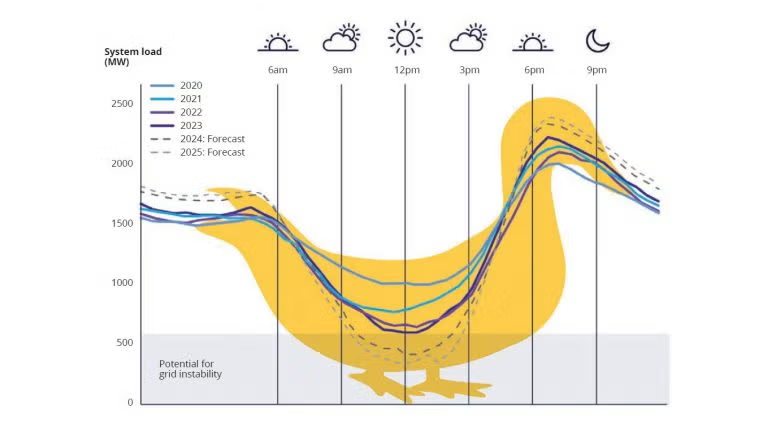
Western Australia faces unique challenges because its main grid, the Southwest Integrated System, operates in isolation from the eastern states. The long distances between population centres and the rapid growth of rooftop solar have created pronounced low-demand periods during the middle of the day. This pattern, often described as a duck curve, increases the difficulty of balancing supply and demand while keeping voltage and frequency within safe limits.
To address this, grid operators and utilities have turned to synchronous condensers. These devices provide reactive power and system strength without producing electricity. In Western Australia, existing gas turbines have been adapted to perform this function, delivering stability services even when the turbines are not generating power. This approach avoids the need to build entirely new infrastructure while preserving reliability during the energy transition.
A key example is the Pinjar Power Station near Perth, operated by Synergy. The facility consists of multiple gas turbines that can start rapidly during peak demand or emergencies. Several units have been upgraded with specialised clutches that allow the generator to remain connected to the grid as a synchronous condenser after the turbine disengages. In this mode, the machine supplies inertia and voltage support, strengthening the grid during periods of high renewable output or low demand.
This modification delivers multiple benefits. Reactive power from synchronous condensers improves voltage stability, increases transmission efficiency, and reduces the risk of blackouts. It also allows gas turbines to earn revenue from ancillary services rather than sitting idle for long periods. As coal plants such as Muja and Collie are scheduled for closure later this decade, the stabilising role of these upgraded gas units becomes increasingly important.
Western Australia’s broader decarbonisation strategy includes major investments in renewable generation, battery storage, and transmission expansion. However, authorities recognise that gas-fired assets remain essential for firming and system security. By converting gas turbines into dual-purpose assets, the state can support higher renewable penetration while maintaining a resilient and reliable power system.
As renewable energy continues to grow, the adaptation of gas turbines into synchronous condensers highlights how existing infrastructure can be repurposed to meet modern grid needs. For Western Australia, this approach offers a practical pathway to stability during one of the most ambitious energy transitions in the country.