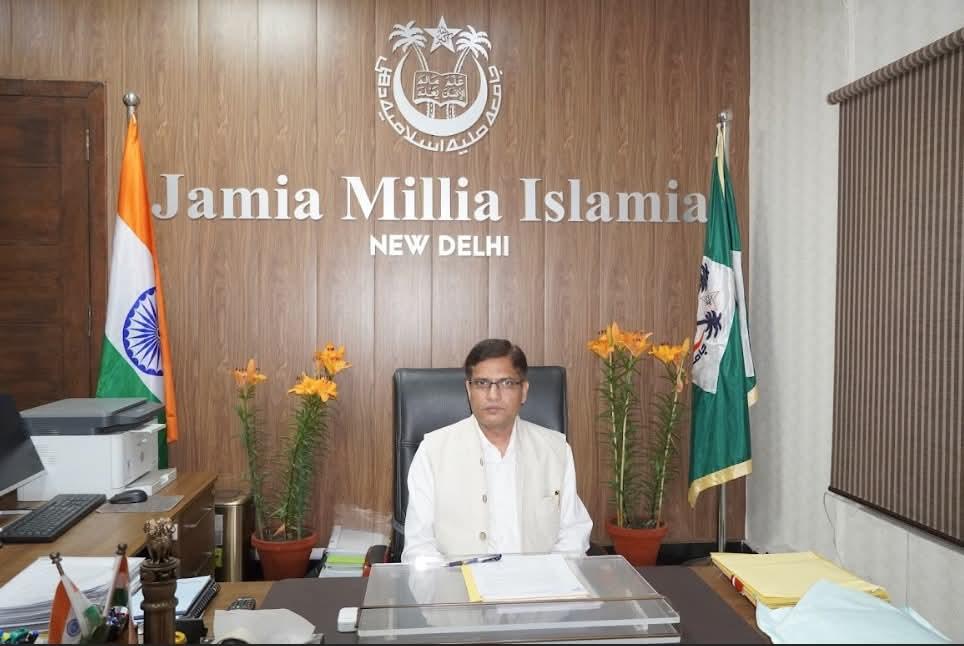
NEW DELHI, India: The controversy surrounding Jamia Millia Islamia and its Registrar, Prof. Md. Mahtab Alam Rizvi, has now moved far beyond a dispute over one media report, one legal complaint or one individual’s reputation. It has become a far more serious test of institutional accountability, freedom of expression and judicial restraint in a constitutional democracy. The issue is not whether Prof. Rizvi has the right to defend his reputation. He unquestionably does. Nor is the issue whether journalists or citizens possess the right to publish falsehoods with impunity. They do not. The real issue is what happens when serious and widely published questions concerning the appointment, qualifications and career progression of a senior official of a Central University are restrained through an ex parte interim judicial order before the truth or falsity of those questions has been finally determined. That is the central constitutional paradox now confronting Jamia and the judiciary: the allegations have not been judicially established, but neither have they been judicially disproved; yet the public discussion surrounding them can be ordered to disappear.
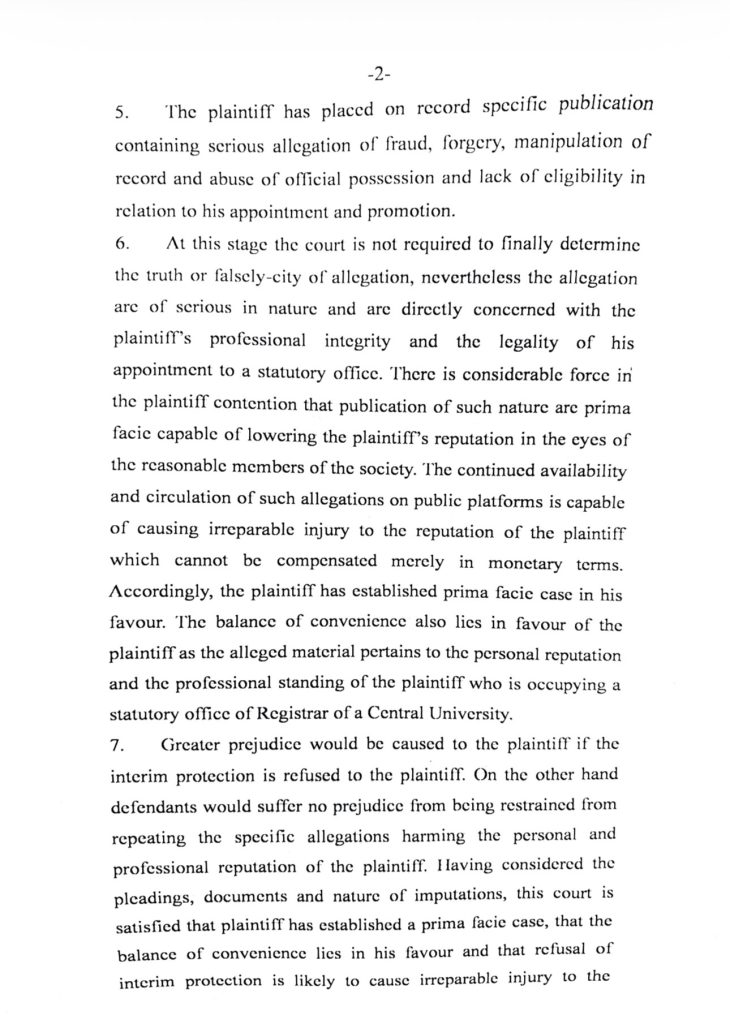
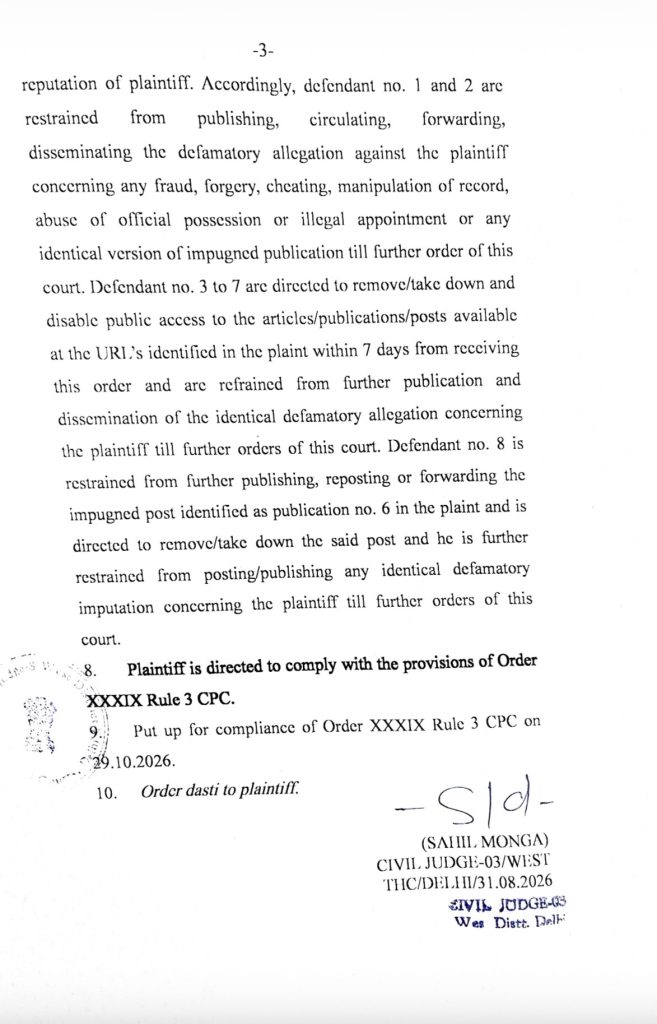
The court order itself makes the contradiction stark. It records that Prof. Rizvi, as plaintiff, approached the court seeking an injunction against the publication and dissemination of allegations concerning his qualifications, appointment, promotion and eventual appointment as Registrar. The order notes that allegations of fraud, forgery, cheating, manipulation of records, abuse of official position and illegality in appointment were being circulated against him. Crucially, the court expressly observed that at the interim stage it was not required to finally determine the truth or falsity of the allegations. Yet the court proceeded to find a prima facie case, held that continued circulation could cause irreparable injury to the plaintiff’s reputation, restrained further publication of the specified allegations and directed the removal or disabling of identified publications and posts. In effect, the factual dispute remained unresolved, but the speech about that dispute was immediately curtailed.
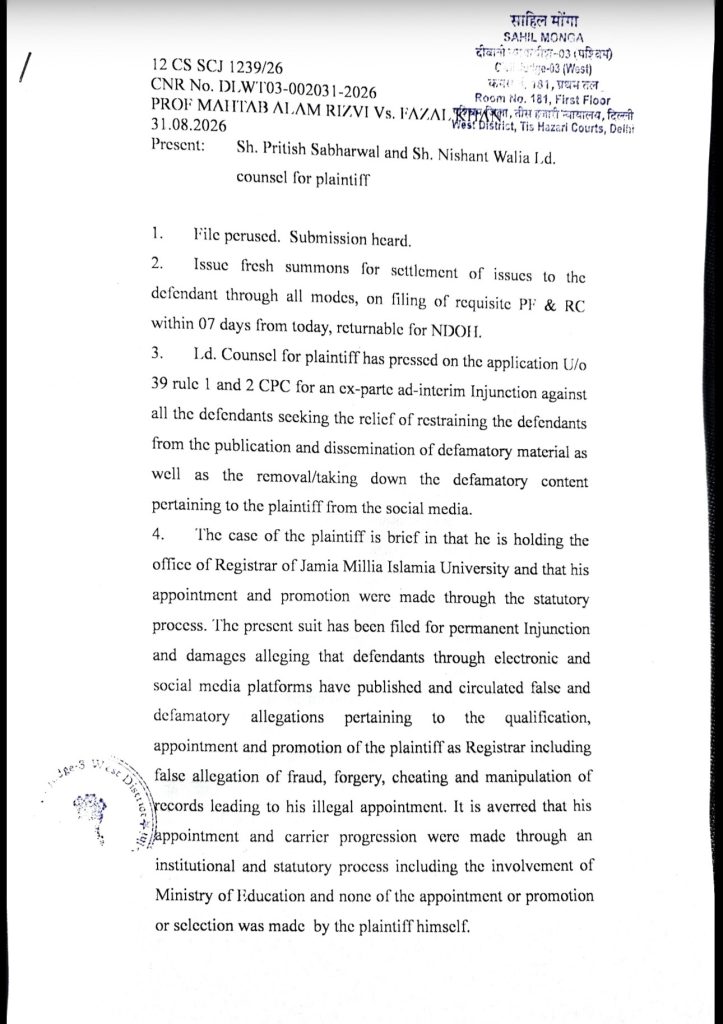
That should concern every citizen, journalist, academic and constitutional institution in India. If a court has not yet determined whether allegations are true or false, on what democratic principle should the public conversation about those allegations be silenced before the underlying evidence is tested? The danger is not that a court protects reputation; the danger is that the remedy for possible reputational harm may itself extinguish the space in which facts can be questioned, documents examined and institutional power scrutinised. A judicial injunction may be legally described as temporary. In journalism and public debate, however, temporary silence can become permanent. News is time-sensitive. Public controversies do not wait for the conclusion of civil litigation. An article removed today may be legally restored months or years later, but by then the public debate may be over, the officials may have moved on and the institutional decisions that required scrutiny may already have become irreversible. A story can therefore survive legally and still die publicly.
What makes this case particularly uncomfortable is that the questions surrounding Prof. Rizvi were not presented in a vacuum. A published report by OpIndia said a criminal complaint had sought registration of an FIR against him and others involved in his academic appointment and subsequent career progression, raising allegations concerning his qualifications, claimed professional experience and compliance with the applicable eligibility framework. The report said the complaint questioned, among other things, the treatment of his experience at the Manohar Parrikar Institute for Defence Studies and Analyses and experience claimed in Ethiopia, alleged inconsistencies in versions of his curriculum vitae, and sought scrutiny of the entire chain of his appointment as Associate Professor, promotion as Professor and eventual appointment as Registrar. The report further said that the complaint sought examination of the role of the Screening Committee, Selection Committee, Executive Council and other university authorities. These are allegations contained in a complaint, not findings of guilt, and no responsible analysis should pretend otherwise. But the seriousness of the allegations is precisely why the response should be verification and transparency rather than the premature disappearance of public discussion. (OpIndia)
The question that neither Jamia nor the judiciary can escape is therefore simple: if Prof. Rizvi’s appointment was entirely regular, if his eligibility was properly assessed and if every stage of his professional progression complied with applicable rules, why should transparent documentary clarification not be the strongest possible answer? The UGC maintains a detailed regulatory framework governing minimum qualifications and standards for academic appointments. The rules exist because universities are not supposed to appoint academic personnel on institutional faith alone; they are supposed to apply measurable standards of qualification, experience and procedure. The existence of a complaint challenging how those standards were applied does not establish wrongdoing. But neither does the existence of an institutional appointment automatically end the right to ask whether the rules were correctly applied. (University Grants Commission)
The deeper problem begins when a person holding a statutory office in a Central University seeks to transform questions about a public appointment into a purely private dispute over reputation. Prof. Rizvi’s reputation matters. But so does the public’s interest in the integrity of the office he occupies. The Registrar of a major Central University is not an obscure private employee whose professional history is irrelevant to public life. The office carries administrative and institutional authority. Questions concerning eligibility for the academic career through which an individual reached such a position may therefore have a public-interest dimension that cannot simply be erased by describing all scrutiny as defamatory. Does holding public office not bring with it a greater obligation to withstand legitimate scrutiny? Does institutional power not require institutional transparency? And should the law distinguish between a malicious fabrication and reporting based on documents, complaints, official records and publicly available material?
This becomes even more troubling because Jamia has already faced a series of public controversies concerning transparency. Students recently protested alleged irregularities in the 2026–27 spot-admission process, questioning whether candidates lower in waiting lists received seats ahead of those ranked above them and challenging the shift to an offline process. The university rejected the allegations as baseless and maintained that its admission system was transparent. Yet the protests were followed by the suspension and campus ban of four students. The university cited alleged misconduct and disruption, while the protesting students and their organisation continued to demand transparency and dialogue. Again, allegations do not prove irregularity. Students can also be subject to legitimate disciplinary rules. But the institutional question remains devastatingly simple: when students raise questions about an admission process, why does the public debate appear to move more quickly towards discipline than towards radical transparency? If the process was fair, the university should be able to demonstrate the waiting-list movement, vacancies, criteria and reasons for every decision. Administrative punishment does not prove institutional innocence. Documents do. (The Indian Express)
The controversy over academic appointments has also not been limited to Prof. Rizvi. The New Indian Express recently reported scrutiny surrounding the appointment of Dr. Masud Alam as an Assistant Professor at Jamia’s Arabic Department, including allegations concerning possible links to the Vice-Chancellor and questions about the appointee’s past. The publication explicitly stated that some claims could not be independently verified and that the status and outcome of the alleged criminal case referred to in the report could not immediately be confirmed. That journalistic qualification is critical. No allegation should be converted into a verdict. But the same principle must operate in reverse: an allegation that has not been proved is not automatically an allegation that can never be discussed. Public institutions should not demand that journalism reach the standard of a criminal conviction before it is permitted to ask whether a public appointment deserves scrutiny. (The New Indian Express)
The wider national context makes the attempt to restrain public scrutiny even more serious. The Reporters’ Collective has recently published a major investigation into alleged recruitment irregularities at Jawaharlal Nehru University, reporting that documents it reviewed indicated that at least seven appointments may have violated UGC requirements and raising questions about the role of JNU’s Internal Quality Assurance Cell and institutional decision-making. The investigation said candidates allegedly rejected at earlier stages were subsequently brought back into consideration, while dissenting voices within university governance raised objections. These too remain allegations and findings reported by the publication rather than judicial conclusions. But the importance of such reporting lies precisely in the fact that institutions of higher education are public institutions exercising enormous power over careers, research and the future of young people. If the media cannot report serious documentary allegations until every legal question has been conclusively decided, then by the time public scrutiny becomes permissible, the appointment process may have long been completed and the accountability question may have become meaningless. (Reporters’ Collective)
This is where the judiciary must examine its own constitutional responsibility with far greater seriousness. Courts are not merely arbiters of private disputes. They are guardians of fundamental rights. That includes the freedom of speech and expression guaranteed under Article 19(1)(a). Of course, this freedom is subject to reasonable restrictions, and reputation is legally significant. But an interim restraint on speech is an extraordinary exercise of state-backed power because it changes the position of the public before the merits have been finally decided. The court order in this case effectively accepts that the truth of the allegations has yet to be determined while simultaneously preventing further circulation of those allegations and directing the removal of identified material. Should a court be comfortable with this asymmetry? The plaintiff’s claim of reputational injury is protected immediately, but the defendants’ claim to publish and the public’s interest in receiving information are restrained before their full defence is heard.
The judiciary must therefore confront a question that is uncomfortable precisely because it concerns judicial power itself: can a court order intended to protect reputation become, in practical effect, an instrument of censorship? The answer cannot simply be dismissed because the order is formally temporary. In the age of digital journalism, the effect of removal is immediate and often irreversible. A news report disappears from search results. A publication loses the ability to update or defend its reporting in the public domain. Readers lose access to the original material. Other journalists observe the litigation and may decide that investigating powerful institutions is simply too expensive or dangerous. That is how a chilling effect works. It does not require the formal abolition of press freedom. It requires only enough examples to persuade journalists that certain questions are legally hazardous to ask.
The question is particularly grave when the person seeking protection is not powerless against the media but occupies a high statutory office within a major university. The court order itself recognises the importance of the plaintiff’s position as Registrar of a Central University in assessing reputational injury. But should that same status not also strengthen the argument for public scrutiny? Why should holding high office increase the need to protect a reputation while reducing the public’s ability to question how that office was reached? If a senior official’s professional history becomes the subject of documented allegations involving eligibility, appointments and institutional verification, the public interest does not disappear merely because the allegations may be damaging. Serious allegations are usually damaging. If reputational damage alone becomes the dominant basis for removing them before factual adjudication, the law risks producing a dangerous formula: the more powerful the person, the greater the reputational consequence of scrutiny and therefore potentially the stronger the argument for silencing scrutiny.
That would invert the democratic purpose of public accountability. Power should attract greater scrutiny, not greater insulation from scrutiny. A university can survive criticism. A senior official can survive questions. An institution can survive an independent inquiry. What destroys public confidence is the appearance that questions are being removed before answers are provided. Jamia has an opportunity even now to demonstrate the strength of its systems. It can clarify the documentary basis on which Prof. Rizvi’s qualifications and experience were assessed, within the limits of privacy and law. It can explain the procedures through which his appointments and career progression were processed. It can publish the relevant institutional framework and demonstrate that the statutory bodies acted in accordance with applicable rules. If the allegations are baseless, such transparency would strengthen both the university and Prof. Rizvi. But if public scrutiny is answered principally through legal restraint while the underlying institutional questions remain publicly unanswered, the university risks creating the impression that its concern is not merely falsehood, but scrutiny itself.
The judiciary also has a responsibility not to become the mechanism through which institutions avoid answering uncomfortable questions. Judicial independence does not mean judicial power is beyond criticism. On the contrary, a constitutional judiciary must be prepared to examine whether its own orders have unintended consequences for democratic freedoms. The right to reputation is real. But the right to speak, publish, investigate and receive information is also real. Courts should therefore be exceptionally cautious before granting relief that removes journalism from public view when the disputed material concerns matters of institutional governance and the facts themselves remain unresolved. Could a narrower remedy have been considered? Could a response, clarification or right of reply address some of the alleged injury? Could disputed factual claims remain available with appropriate qualification rather than being removed altogether? Was there such an immediate danger that the defendants’ right to be fully heard had to give way to an immediate restraint? And where, in this balance, is the independent weight given to the citizen’s right to know?
These are not questions designed to attack the judiciary. They are questions designed to defend the constitutional principle that the judiciary itself is entrusted to protect. A democracy cannot meaningfully celebrate freedom of speech while allowing the exercise of speech to become increasingly dependent on whether the speaker has enough money to survive litigation. A university cannot demand unquestioning respect for merit while serious questions about the merit-based integrity of its own appointments are met with secrecy or suppression. And public institutions cannot restore trust by insisting that criticism itself is the problem.
The most dangerous outcome of the Jamia controversy would not be a final legal victory for either side. It would be the creation of a broader precedent in public culture: when uncomfortable questions are raised about powerful institutions, do not answer them; obtain an injunction. That lesson would reach far beyond one university. It would reach student journalists, independent media organisations, researchers, whistleblowers and ordinary citizens. It would tell them that the risk of questioning authority is not merely being wrong. The risk is being silenced before a court even decides whether the questions were justified.
Prof. Rizvi deserves the full protection of law against malicious and demonstrably false allegations. That principle is non-negotiable. But the same constitutional order must protect the right of citizens and journalists to question public institutions, especially where allegations concern appointments, qualifications, recruitment and the exercise of statutory power. The answer to allegations is not necessarily conviction. But neither should the answer to allegations automatically be silence. Investigation is how truth is separated from falsehood. Transparency is how institutions earn trust. Judicial scrutiny is how rights are protected. When any one of these mechanisms is used to close the others, democracy begins to lose its balance.
Jamia’s crisis, therefore, is no longer only about one Registrar’s appointment, one complaint, one admission dispute or one faculty selection. It has become a test of whether Indian universities still understand that public confidence cannot be commanded. It must be earned. And the judiciary now faces its own test: will courts protect reputation without allowing the remedy to become a shortcut for suppressing public-interest scrutiny? The danger of a gag order is not simply that one article is removed. The deeper danger is that an entire generation of journalists and citizens learns to remain silent.
That would be the greatest institutional failure of all.
Because in a democracy, the question should never be whether power is comfortable with scrutiny. The question is whether citizens remain free to ask.
-William Jones